Career Connection: 1st Generation Farmer
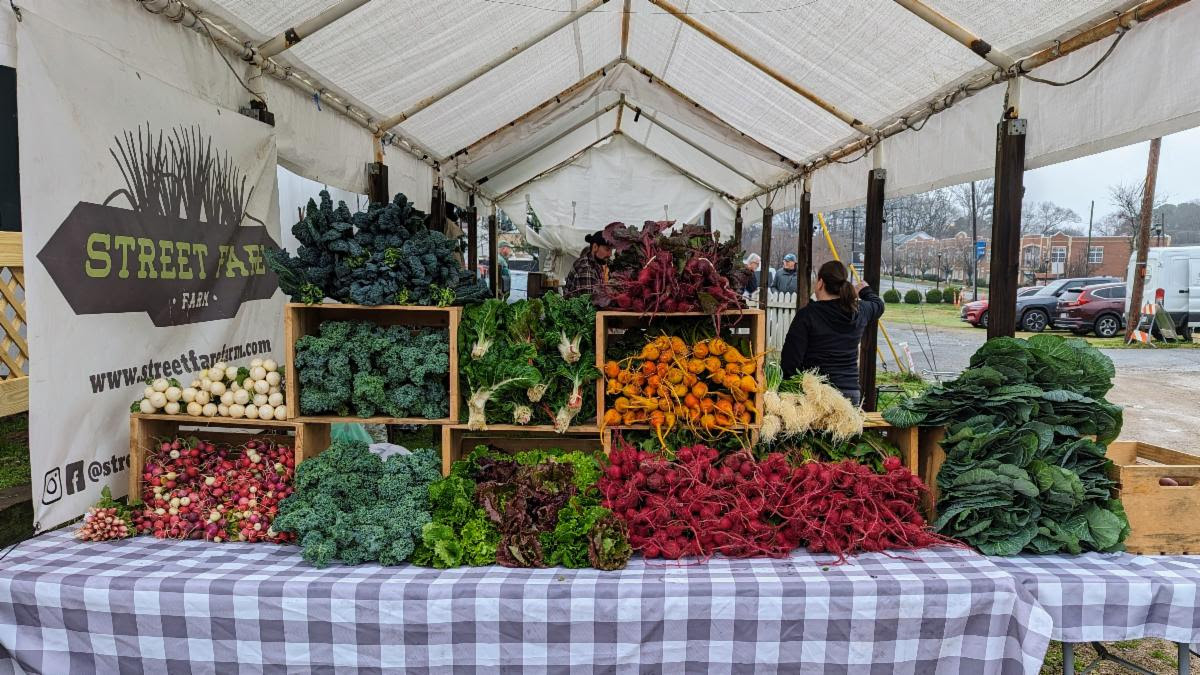
The job title “Farmer” can bring a lot of assumptions to mind. Our profile of Ben Street offers a look at one farmer–a produce farmer, focused on sustainable agricultural production on only two acres. He markets direct to consumer, and through wholesale channels. Ben didn’t grow up on a farm and had no childhood experiences with gardening – like most of our students today – yet, he found this career by diving deeper into nutrition for optimal health.
Name: Ben Street
Organization: Street Fare Farm, LLC
Position: Owner/Operator

Q. What do you do?
A. At Street Fare Farm, we produce seasonal fruits and vegetables year-round on 2 acres using bio-intensive, regenerative practices. We market our produce through the Matthews Farmers Market, a 24-week CSA program, and wholesale to restaurants, food distributors and purveyors.
Q. What was your path to your current career?
A. I grew up in the Virginia suburbs of Washington D.C., and moved to Charlotte, NC, in 2012 for work. I’ve always had a passion for exercise and fitness, but became interested in diet and nutrition once it became evident that exercise alone wasn’t enough to maintain optimal health. My research into nutrition led me into the realm of sustainable agriculture and the lack of those practices (and benefits) in many of our conventional agricultural systems.
One night, while lying in bed, trying to figure out the direction I wanted my life to move in, I had the epiphany that I might try my hand at farming. I began reducing my expenses and saving as much money as I could. I even went so far as living in a camper for two years in order to save money! I started volunteering at a local farm, and was introduced to the Lomax Incubator Farm in Concord, NC. After volunteering for a year, attending the monthly meetings at the Lomax Farm, and a brief stint in Brooklyn, NY, I started Street Fare Farm in early 2015. I spent the first season farming in the off-hours of my day job as a freight forwarder. That was the hardest summer of my life! I was pretty burnt out by the end of that first summer, and decided to reduce my production for the fall. My plan was to keep working the day job one more year to save up some more money, and then make the leap to farming full-time in 2017. Then tragedy struck.
In October of 2015, my little brother passed away suddenly after a long struggle with drug addiction. He left behind a beautiful little girl, my darling niece. This loss rocked my family, and had a profound impact on me. I had never lost anyone so close. He and I were only 13 months apart; we grew up together. I was overwhelmed by a sense of the fragility of the time we have on this earth, and, whether in spite of or in honor of my brother, decided that if I wanted to follow this dream and become a farmer, then there was no time like the present. So, in early 2016, I left my full-time job and made the leap to farm full-time.
In 2019, I had the greatest privilege of my life to connect with Alisha, who was then running the Bulb Mobile Markets, a non-profit she founded in 2016 to serve local and rescued produce to food insecure individuals in the greater Charlotte metropolitan area. What originally started as a business relationship turned romantic, and in 2020 we were married and quickly grew our family with the addition of our son, Danny, and daughter, Millie. Alisha’s heart is to serve, and her soul thrives out in nature. Together our goal is to provide the freshest, healthiest food for our family, friends and community, and to inspire others to develop a connection to this planet that sustains our life.

Q. How important are math, science and communication skills to finding success in your field?
A. It is essential to have a working and practical knowledge of math, science and communication skills in order to run a successful, direct-to-consumer farming operation. Math is used daily in order to calculate production plans, seed requirements, seeding rates, pricing, budgeting, record-keeping, etc. When it comes to science, having a basic understanding of biology and chemistry can be the difference between having a successful crop and an unsuccessful one! Though we as humans have only a limited understanding of the true dynamics of what is occurring at the sub-soil level, understanding the basic nature of soil health and chemical balances ensures strong production and consistent results. As for communication, I would not be in business if it weren’t for the customers who support us by purchasing our produce, and that requires developing relationships, which is done through communication. Admittedly, this is not my biggest strength, but I’ve learned that the more you can communicate with those who support you, the better the outcomes that can be achieved.
Q. What is most fulfilling about your career?
A. The most fulfilling aspect of farming is the humility that is developed in working with the very elements of life itself, and therefore the growing desire to not become just a better producer, but a better steward of this Earth and facilitating and encouraging the health thereof. The ability to directly reap what has been sown is also extremely fulfilling, and is something I fear not many have the privilege of experiencing in our modern age.
- Categories: